
AI Leadership - Board Room Essay #9
Seven Reasons Why AI Fails to Scale
By Tom Lawry - August 21, 2026
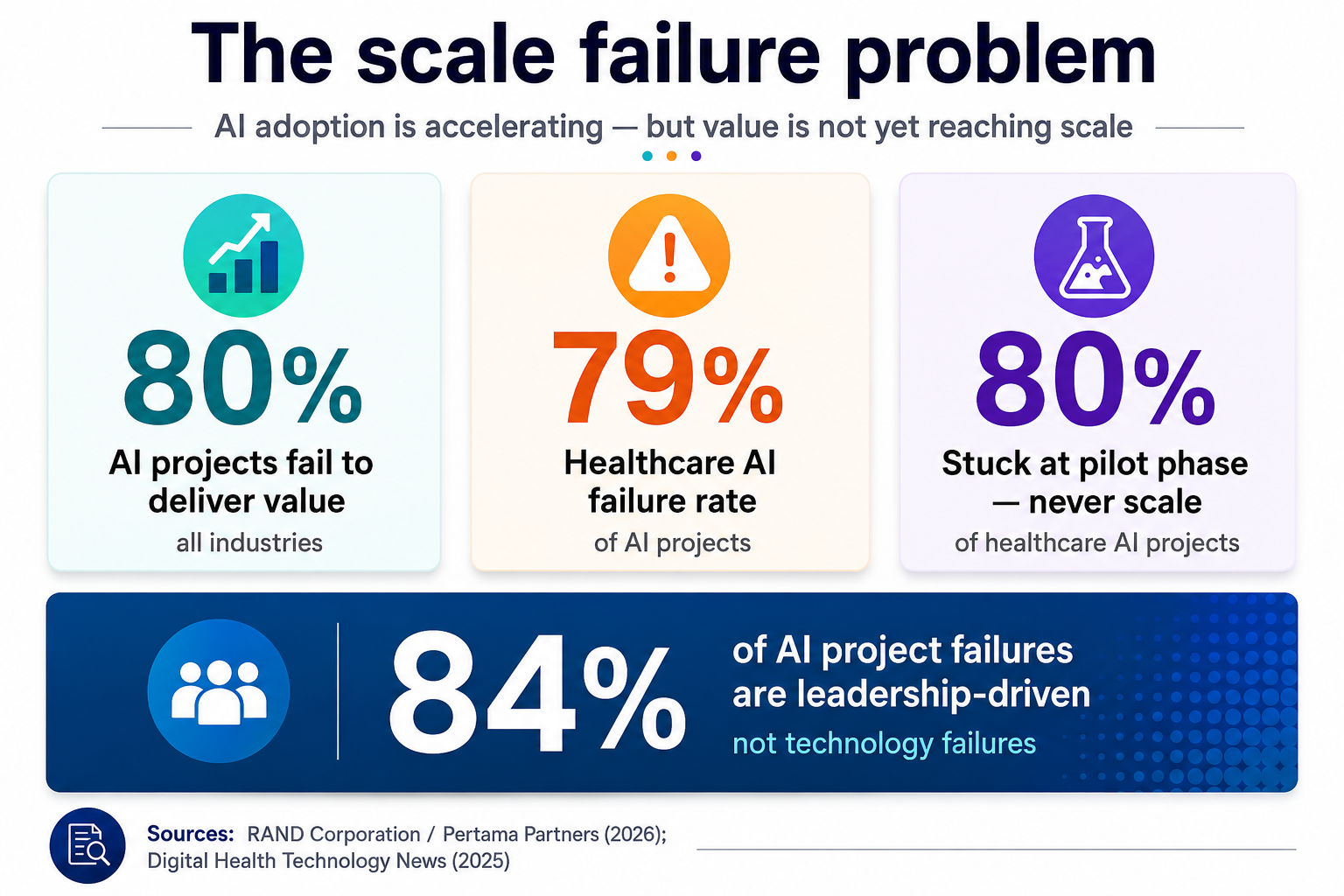
Across industries, more than 80% of AI projects fail to deliver intended value; in healthcare the rate is nearly 79%. The technology works. Leadership creates the conditions for success or failure. This Board Room Essay identifies seven evidence-backed reasons healthcare AI innovation fails to scale—from undefined value and stalled pilots to unready data, weak governance, neglected change management, and eroded trust—and offers a test leaders can apply before approving their next AI investment.

Healthcare has reached an interesting paradox. AI adoption is accelerating and investments are growing. Yet most organizations are not seeing measurable value scale across clinical outcomes, financial performance, or operations.
Analyses drawing on research from RAND and Deloitte find that across industries, more than 80% of AI projects fail to deliver intended business value. In healthcare, the failure rate runs nearly 79%—driven not by technology shortcomings, but by predictable, preventable organizational failures.
Let me say that more directly.
AI technology typically works. Leadership creates the conditions for its success or failure.
Here are seven evidence-backed reasons health AI initiatives stall, plateau, or underperform in delivering value.
1. No Clear Definition of Value Before You Start
Many organizations deploy AI without first agreeing on what success looks like. Metrics are vague or disconnected from clinical or financial performance. Without pre-defined baselines and agreed KPIs, projects get declared ‘complete’ at go-live rather than at value realization.
The evidence is clear. According to an analysis by Pertama Partners, 73% of failed AI projects lack clear executive alignment on success metrics. The same analysis found that organizations with pre-approval metrics achieve a 54% success rate—compared to just 12% without them.
Organizations that define success metrics before deployment are more than four times as likely to achieve meaningful results. Alignment on outcomes is not a planning formality—it is the foundation on which everything else depends.
2. Pilots That Go Nowhere
Healthcare is highly adept at piloting AI. Industrializing pilots is another matter. Industry data reported by Health Technology Digital finds that two-thirds of healthcare AI projects fail to scale beyond the pilot phase.
The pattern is familiar: a proof of concept produces encouraging results, gets presented at a leadership meeting—and then stalls. No workflow integration, no change management plan, no enterprise rollout budget, no executive owner.
A pilot that never scales is not a success—it is a deferred failure. Scale architecture, governance, and change management must be considered or designed before investing in a pilot.
3. AI Chasing the Wrong Priorities
Many AI investments are driven by vendor marketing, peer benchmarking, or departmental enthusiasm rather than enterprise strategic need. The result is a portfolio of capabilities that does not address what leadership is actually accountable for: cost reduction, quality metrics, patient access, margin improvement.
Implementation research published in PLOS ONE reinforces the point: strong AI programs begin not with tools but with strategy—mission, vision, goals, guiding principles, and measurable desired outcomes—established before any vendor conversation begins.
Organizations that move into pilots before deciding what problem AI should solve almost always end up with impressive technology serving no one’s priorities.
4. Data Not Ready
AI performs only as well as the data it consumes—and in healthcare, data readiness is often a systemic failure hiding in plain sight. The consequences are measurable. Gartner estimates that 85% of AI models fail due to poor data quality.
In a 2024 survey of health system executives reported by Mesh Digital Insights, 33% identified poor data quality as a top barrier to scaling digital and AI initiatives, and legacy IT infrastructure was cited as the second-greatest transformation obstacle, behind only budget constraints.
Data readiness is not an IT problem. It is an executive governance responsibility. Organizations that treat data as a strategic asset—with clear ownership, quality standards, and interoperability architecture—create the foundation for AI that delivers.
5. Weak or Absent AI Governance
Deployment is outpacing governance. Data presented at HIMSS 2025 shows that only 23% of health systems have formal AI governance structures—yet 78% plan to deploy clinical AI within 24 months.
The gap is consequential. The same research found that 70% of hospital leaders report at least one AI pilot failure due to weak endpoints, workflow misalignment, or data gaps, and 80% say it is difficult to verify vendors’ AI claims without formal governance.
AI governance is not a compliance function. It is an executive accountability structure that answers three questions: Who owns the AI strategy? Who owns the risk? Who owns deployment standards and monitoring?
Governance must be built before scale—not retrofitted after a failure.
6. Change Management Treated as an Afterthought
AI implementation is too often treated as a technology project rather than a people-and-process transformation. Healthcare workers frequently perceive AI as a threat to their autonomy or expertise—a pattern that a systematic review published in Cureus identifies as a primary barrier to adoption—and when leadership fails to address this, most initiatives stall.
The solution is not a training module. It is sustained investment in workflow redesign, frontline champions, transparent communication, and structures through which staff can raise concerns and see them addressed.
You cannot automate your way past people. Change management is not a soft add-on to AI programs. It is where the majority of the implementation investment belongs, and where most organizations chronically underinvest.
7. Erosion of Clinician and Patient Trust
Even technically sound AI will fail at scale if clinicians do not trust it or patients will not accept AI-assisted decisions.
Trust erodes when recommendations are opaque, when clinicians have no mechanism to challenge outputs, or when patients discover their care was influenced by a system they did not know existed—dynamics documented in Tebra’s survey of 1,900 healthcare professionals and 16,000 patients across 16 countries.
A comprehensive review of 92 studies published in Safety Science identifies trust, transparency, and explainability as the most critical determinants of clinician acceptance.
Building durable adoption requires making AI recommendations explainable at the point of care, creating formal staff feedback mechanisms, and communicating openly—with both workforce and patients—about AI’s role in care delivery.
Trust is not a byproduct of good technology. It is built through transparency, explainability, and mechanisms that give clinicians genuine authority to question what the algorithm produces.
The Pattern Underneath the Patterns
AI failure in healthcare is rarely a technology problem. It is a leadership problem—and that is, in a way, good news.
These seven failure modes are not random. They cluster around a single common deficit: organizations that treat AI as a procurement decision rather than a transformation program.
They buy before they define. They pilot before they govern. They deploy before their data is ready. They go live before their people are prepared.
Organizations that succeed share a different profile—one documented in the Scottsdale Institute’s survey of 43 U.S. health systems. They define success before selecting tools. They treat data as a strategic asset. They build governance before deploying at scale. They invest in change management with the same rigor as implementation. And they treat trust—with clinicians, patients, and frontline staff—as a prerequisite for adoption, not a hoped-for byproduct.
Prediction: The gap between AI leaders and laggards in healthcare will be determined not by who buys the best technology, but by who builds the best conditions for technology to succeed.
Recommendation: Before approving your next AI investment, run it against these seven failure modes.
The question is not whether your organization will encounter these failure modes. Most already have. The question is whether you understand them well enough to interrupt the pattern—and build something that actually delivers.
That is not a technology decision. It is a leadership one.