AI Leadership - Board Room Essay #001
Find and Follow AI's True North
By Tom Lawry - August 16, 2026
AI technology creates potential — leadership determines whether value is achieved. In this Board Room Essay, healthcare AI strategist Tom Lawry explains why AI success in healthcare depends not on the technology purchased, but on the leaders deploying it. Drawing on almost two decades of experience, Lawry contrasts technology-first strategies with an empowerment approach that starts with people, builds the AI value flywheel, and delivers measurable outcomes at scale.

“Technology is nothing. What’s important is that you have faith in people.”
— STEVE JOBS
Walk into the exhibit hall of any medical, life science, or IT conference, and the noise hits you immediately — hundreds of vendors, each promising that their AI-infused solution will transform your organization.
Some of it is true. But here is something you will almost never hear from a vendor, and it is one of the most important messages I can offer:
AI technology creates potential.
Leadership determines whether value is achieved.
Whether an AI solution delivers measurable, scalable value has almost nothing to do with what you purchase or license from a vendor. It has almost everything to do with you — the leader who deploys it, the culture that surrounds it, and the clarity of purpose that drives it.
Every AI solution you purchase starts as a capital or operating expense. On its own, your investment in hardware, software, or cloud services adds zero value — even when the technology does exactly what it is supposed to do.
The purchase is not the strategy. It is the beginning of the work.
What separates leaders who create value from those who don’t
Over nearly two decades, I have worked alongside brilliant, mission-driven leaders whose singular quest was to make health and medicine better. I have had a front-row seat to both promising successes and expensive failures — and more than enough time to observe what separates leaders who create lasting value at scale from those who accumulate a portfolio of AI pilots that never leave the runway.
The variables differed across organizations — size, market dynamics, data maturity, available capital. None of them were the deciding factor.
When I strip all of that away and search for the single variable that best predicts success, one pattern emerges every time.
The leaders who create what I call the AI value flywheel do not start with technology.
They start with people.
Done right, AI is not about technology. It’s about empowerment.
Whether you are a CEO or a department manager, if you lead from the conviction that AI is about empowering every knowledge worker to be better at the things they care about, your approach and your actions are fundamentally different from those who treat AI primarily as a technology initiative.
And those different actions produce dramatically different results.
The technology-first trap
Many leaders begin their AI journey with a technology-first approach, and it is easy to understand why. Technology moves fast. Vendors are convincing. The pressure to show that your organization is not being left behind is real and constant.
In this model, success gets measured by deployments and adoption metrics. AI strategy gets delegated to IT or a data science division. The C-suite is watching, but not driving.
Frontline staff are expected to adapt to the technology.
Sometimes it works. Often it does not.
Because even brilliant technology cannot fix a broken workflow. It cannot resolve a misaligned incentive or earn the trust of a clinician who was never asked for their input.
When people feel that AI is being done to them rather than with them, the resistance that follows is not a technology problem.
It is a leadership problem.
The empowerment approach
Leaders who treat AI as an empowerment initiative start from a different place entirely.
Instead of asking what the technology can do, they begin by asking a more important question: Where and why are people struggling to do their best work?
Then — and only then — do they ask how intelligence might help.
In this approach, AI becomes a tool for amplifying human capability. These leaders look for friction inside clinical and operational workflows. They look for decision points where better insight could improve care. They look for administrative burdens that are draining time and energy from the workforce. They look at how they can reduce the friction that consumers and patients feel when they turn to the organization in need.
Frontline teams are not passive observers in this process. They are involved upstream. They are partners in shaping how intelligence gets applied.
Planning, deployment, and governance bring clinical and operational leaders alongside technical experts — because the people closest to the work know where the real problems live.
Success is measured not by system utilization but by real improvements in care quality, in decision-making, in workforce experience. Training and upskilling are not afterthoughts — they are line items in the AI budget and commitments to the workforce.
When AI is framed this way, it stops being a technology project. It becomes a workforce strategy and a competitive differentiator.
Two kinds of leaders. Two very different outcomes.
The difference between these two approaches might seem subtle on paper. Inside organizations, it changes everything. It shows up every day — in concrete decisions, at every stage of planning and execution.
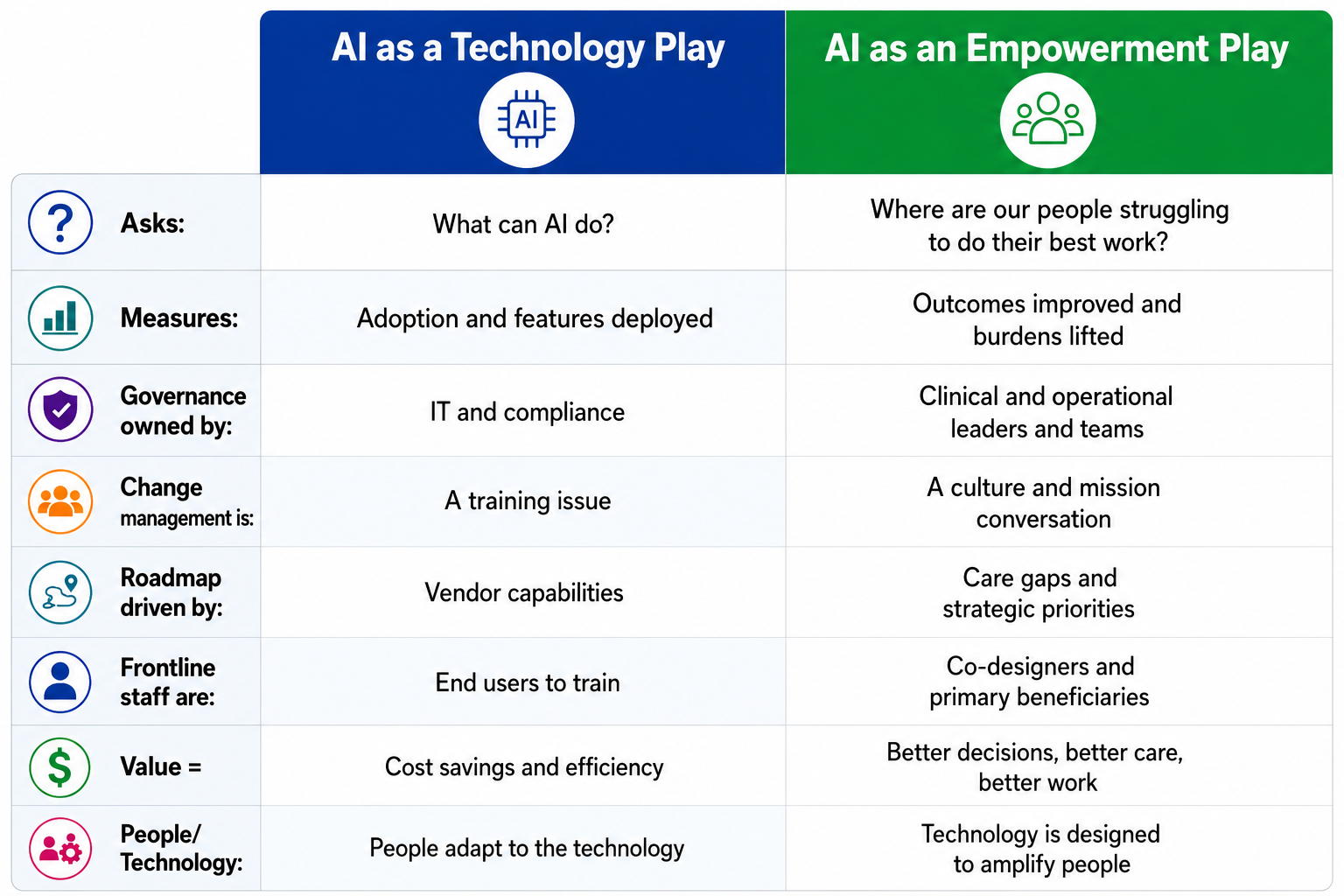
Take a hard look at the table below and ask yourself honestly: which column describes how your organization is operating right now?
Let’s be clear about one thing: leaders on both sides of this table want to do right by their organizations and those they serve. The difference is not in their intentions. It is where they anchor their thinking. That anchoring determines everything downstream.
One starts with the tool and works outward. The other starts with the human being — the clinician, the patient, the frontline worker who is either helped or burdened by every decision you make — and works backward to find the technology that best serves them.