
AI and the Workforce - Board Room Essay #5
Stop with the Scary Stuff About AI, Robots, and Job Loss. Read This Instead.
By Tom Lawry - August 21, 2026
The scary-robot headlines have it wrong — and for the first time, global data proves it. Clinicians using AI are reclaiming three full working weeks a year, and the companies investing most heavily in AI are hiring the most people, including entry-level workers. In this Board Room Essay, Tom Lawry separates evidence from fear and shows healthcare leaders how to turn Augmented Intelligence into workforce strategy.

Let's set the record straight.
Yes, AI is creating value by automating — or partially automating — work humans do today.
That trend will continue and accelerate. It will touch nearly every job, and it will displace some workers whose roles consist mainly of highly repetitive tasks.
The McKinsey Global Institute estimates that about 5% of occupations could be fully automated, while roughly 30% of the activities in 60% of all occupations could be automated.
Read those numbers carefully. They don't describe jobs disappearing. They describe jobs changing — with the repetitive, low-value tasks that drive knowledge workers batty being the first to go.
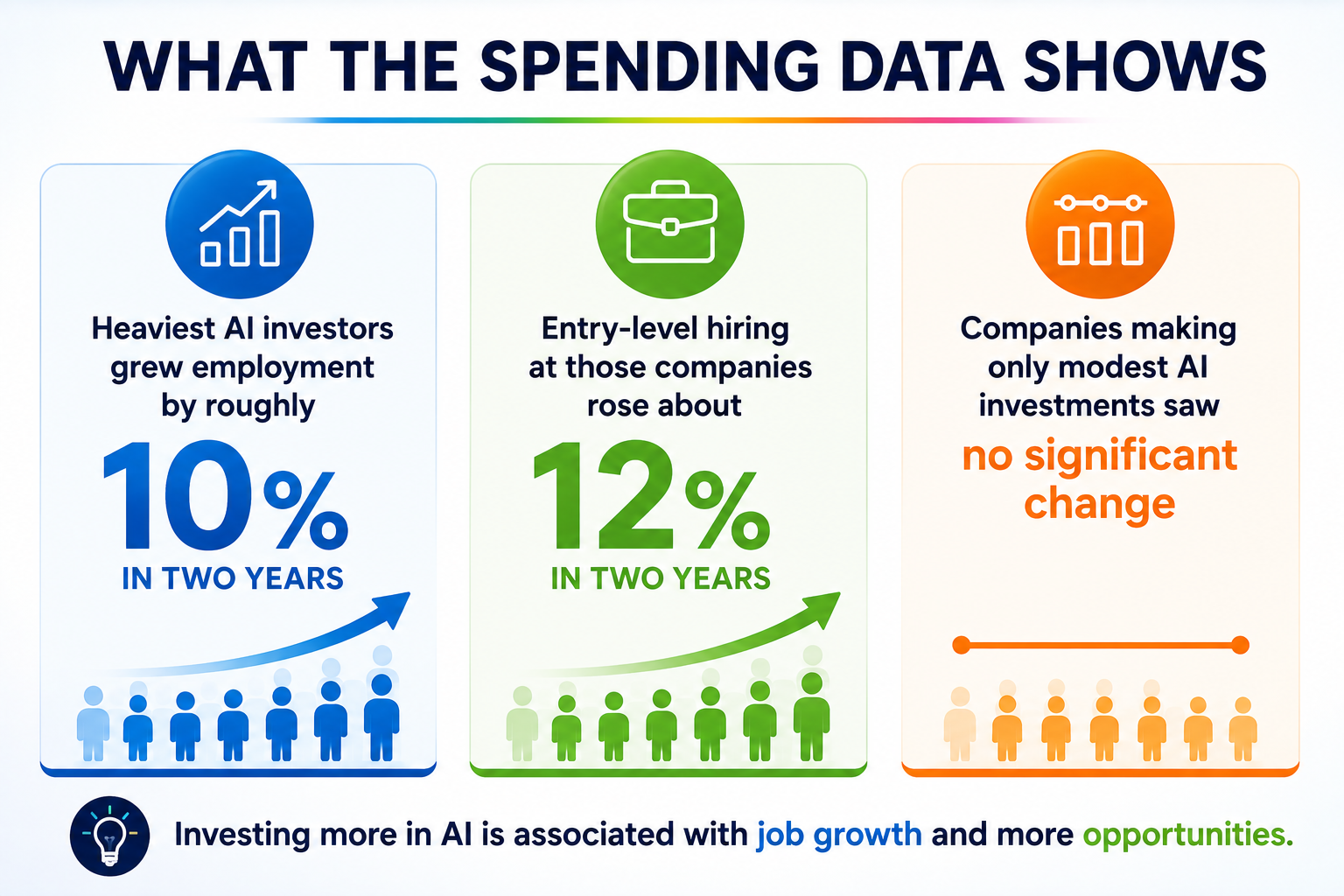
But here's where it gets interesting. A new study from Ramp's Economics Lab and Revelio Labs took a novel approach: instead of surveys or speculation, they tracked what companies actually spend on AI — linking corporate payments to AI vendors with workforce records across more than 21,000 U.S. companies.
What did they find?
The companies spending the most on AI are also spending the most on humans.
It's important to note this is correlation, not proven causation — and that adopters were already growing faster before adoption.
Fair enough. But the early evidence points in one clear direction: deep, sustained AI investment is showing up alongside workforce expansion, not contraction.
That capacity gain isn't just anecdotal — it's now documented at scale. Philips' 2026 Future Health Index found that nearly half of clinicians using AI (46%) reported saving at least 132 hours a year, the equivalent of more than three full working weeks. Many are reinvesting that time directly into patient care: half of those clinicians reported having the capacity to see an average of eight additional patients per week.
The pattern is consistent with what McKinsey and the Ramp/Revelio Labs data show above — AI isn't eliminating the need for clinicians, it's freeing them from lower-value work so they can do more of what only they can do.
And so, let's stop with the creepy robots in healthcare and pay attention to how the companies betting biggest on AI are hiring the most people — including the youngest ones.
Prediction: The dividing line in healthcare will not be humans versus machines. It will be organizations that invest deeply and redesign work around augmentation versus those that dabble — and get neither the productivity nor the growth.
Recommendation: Stop asking “How many jobs will AI eliminate?” Start asking “What will our people do with the capacity AI creates?” The first question breeds fear. The second builds strategy.
Turn Down the Volume
Fear is easy to sell. It always has been. When automobiles first appeared, Red Flag laws required a person to walk ahead of every vehicle waving a warning flag. The fear was real. It was also wrong about the future.
The scary-robot genre is today's red flag — loud, lucrative, and largely unburdened by data.
The data we now have tells a better story: clinicians getting back three weeks a year. Patients getting more of their doctor's attention. The heaviest AI investors hiring the most people.
So every time you see or hear “AI,” think Augmented Intelligence, not the Hollywood stereotype.
Let's turn down the volume on rhetoric that stokes fear — and amp up the conversation about how, when done right, we will use Augmented Intelligence to make healthcare and work itself better.
T.
Sources:
McKinsey Global Institute — automation potential
"A Future That Works: Automation, Employment, and Productivity" (the source of the "~5% fully automatable / ~30% of activities in 60% of occupations" figures), McKinsey Global Institute, January 2017.
https://www.mckinsey.com/~/media/mckinsey/featured%20insights/digital%20disruption/harnessing%20automation%20for%20a%20future%20that%20works/mgi-a-future-that-works_executive-summary.pdf
Primary research paper: "A New Look at AI's Impact on Jobs: Firm-Level AI Spending and Employment," Ramp Economics Lab, 2026.
https://ramp.com/data/ai-jobs-impact/paper
Companion data page: "Companies hire more after AI adoption," Ramp.
https://ramp.com/data/heavy-ai-adopters-hire-more
"Philips Future Health Index 2026: AI is already saving clinicians time and delivering measurable impact in healthcare," Philips, June 2026.
https://www.philips.com/a-w/about/news/archive/standard/news/press/2026/philips-future-health-index-2026-ai-is-already-saving-clinicians-time-and-delivering-measurable-impact-in-healthcare.html