
AI and the Workforce - Board Room Essay #7
What the Nurses of New York Taught Me About AI Adoption
By Tom Lawry - August 21, 2026
Workforce resistance, not technology, is the greatest barrier to healthcare AI at scale. This essay draws on a week spent rounding at a premier academic medical center, sitting at the labor bargaining table, and listening to a nurse in Brooklyn to show why clinicians push back on AI — and why most leadership assumptions about that resistance are wrong. The lesson: AI adoption is a leadership challenge built on trust, not a deployment problem solved by better tools.

I want to thank the nurses of New York for educating me—and for helping me uncover a blind spot I didn’t know I had.
You see, I’m supposed to be an AI expert.
For years, my work has led me to a strongly held belief: done right, AI will reduce administrative and cognitive burden and help restore nurses to the role they most want to play—the ultimate caregiver, coordinator, and patient advocate. (The same is true for physicians.)
That belief isn’t naïve optimism. It’s grounded in more than 15 years of experience working at the intersection of artificial intelligence and healthcare. It’s supported by countless case studies. It shows up in surveys and research from respected organizations like McKinsey and the American Nurses Foundation.
Over and over, the data reinforces the same conclusion: nurses are overwhelmed by documentation, interruptions, and cognitive overload—and AI has real potential to help.
And then, right before the holidays in 2025, I spent a week in New York.
I rounded at one of NYC’s premier academic medical centers and spent time with its nursing leaders.
I sat in on intense, “in-your-face” conversations at the labor bargaining table. (The New York State Nurses Association went on strike two weeks later. AI was an issue.)
And I shared space and ideas with a formidable lineup of nurse leaders such as Dan Weberg, National Executive Director, Nursing Workforce Development and Innovation for Kaiser, and Kellie Bryant, Director for the Center for Innovation in Education Excellence at the National League for Nursing. These and other luminaries had gathered as part of an AI in Nursing Forum sponsored by SEIU-1199.
Each experience chipped away at my assumptions about why some nurses are resistant. But my real awakening came during a breakout session I was running in Brooklyn.
A nurse raised her hand and told her story. She was Hispanic, from an immigrant family. Through collective sacrifice—parents, siblings, extended family—she became the first in her family to graduate from college and become a nurse. Nursing wasn’t just her profession; it was her identity. Her proof of progress. Her hard-won stability.
She wasn’t angry. She wasn’t anti-technology. But she was deeply cautious.
“I’m not against AI,” she said. “I just need to understand it well enough to know it won’t take me backward.”
That stopped me cold. Because in that moment, AI stopped being an abstract “productivity tool” or “innovation roadmap.” It became personal. Emotional. Existential.
She wasn’t resisting AI.
She was protecting what she had earned and what was in the interest of those she served.
And that’s when it hit me: many nurses aren’t evaluating AI through a lens of efficiency or system performance. They’re evaluating it through a lens of emotions about uncertainty and personal risk.
What does this mean for me?
For my job?
For my license?
For my professional judgment?
For the dignity of the work I do?
That’s a profoundly human response.
We fear—or at least resist—what we don’t understand. And when trust is low, the first question isn’t “How could this help nursing?” It’s “How could this hurt me?”
Today, one of the greatest impediments to healthcare organizations realizing value from AI at scale is not the technology.
It’s workforce resistance.
And in most cases, it’s not the workforce’s fault.
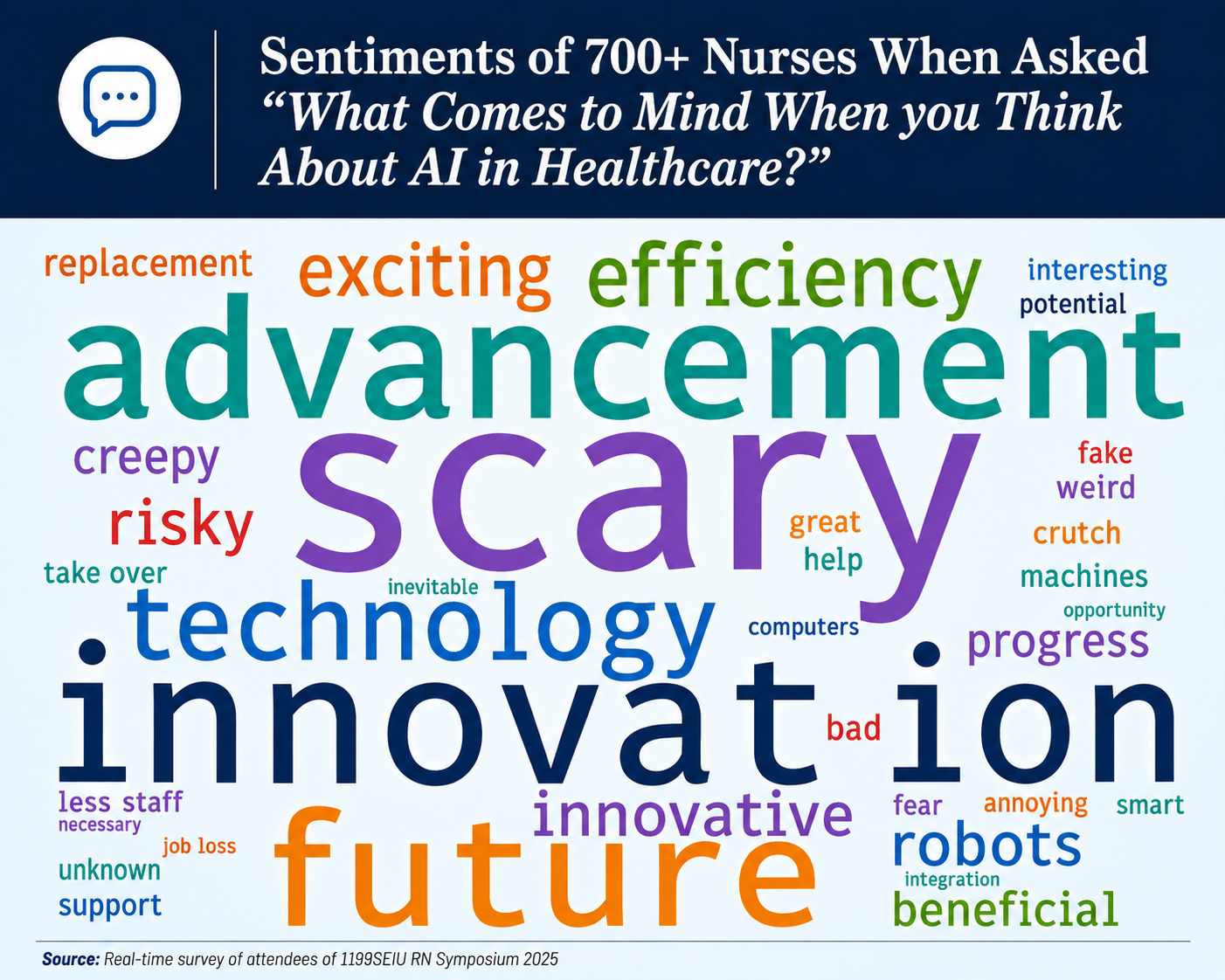
While there are outstanding examples of AI being done right in nursing (and with physicians), there are many organizations implementing AI in ways that leave nurses and physicians feeling like AI is being done to them, rather than designed, implemented, and evaluated with them.
New tools arrive fully formed. Training is rushed. Input is minimal. Accountability, however, is absolute.
In that context, skepticism isn’t fear. It’s self-preservation.
Too many AI strategies start with pilots, platforms, and procurement—and end with nurses being told, “Don’t worry, this will make your life easier.”
Trust doesn’t work that way.
Trust is built when nurses are involved early. It’s built when nurses understand how an AI system works, where it can fail, and who is accountable when it does.
It’s built when organizations invest as much in education and change management as they do in software.
What I heard repeatedly in New York wasn’t opposition to AI. It was frustration with how AI is being introduced.
What nurses want
Transparency, not hype
Training, not platitudes
A real voice, not a token seat at the table
Guardrails that protect professional judgment
If healthcare leaders truly believe AI can help address burnout, staffing shortages, and quality gaps, then we need to confront a hard reality: AI adoption is a leadership challenge, not a technical one.
Leadership means acknowledging fear without dismissing it.
It means slowing down when speed erodes trust.
It means co-creating, not just communicating.
It also means investing in something we too often underfund: AI literacy for nurses.
Because when nurses understand AI, fear gives way to agency.
My experiences with the nurses of New York didn’t change my belief in AI’s potential.
But it changed my understanding of what it will take to realize that potential with nurses.
If we want AI to succeed in healthcare, we must stop treating nurses as downstream users and start recognizing them as co-architects of the future.
The nurses of New York reminded me of something essential: transformation doesn’t begin with algorithms.
It begins with trust.